
Nine decades in outline.
The School began as an enquiry into economic justice. It is still engaged in enquiry today.
What follows is not a complete account. It is a chronology of some of the moments that shaped the School's character and directed its work.
The full story belongs to the students and tutors who lived through it. This outline is offered in the spirit of transparency.
Four of those moments, in view.
- I1937Economic Origins
Leon MacLaren founds the School of Economic Science, exploring questions of justice through political economy.
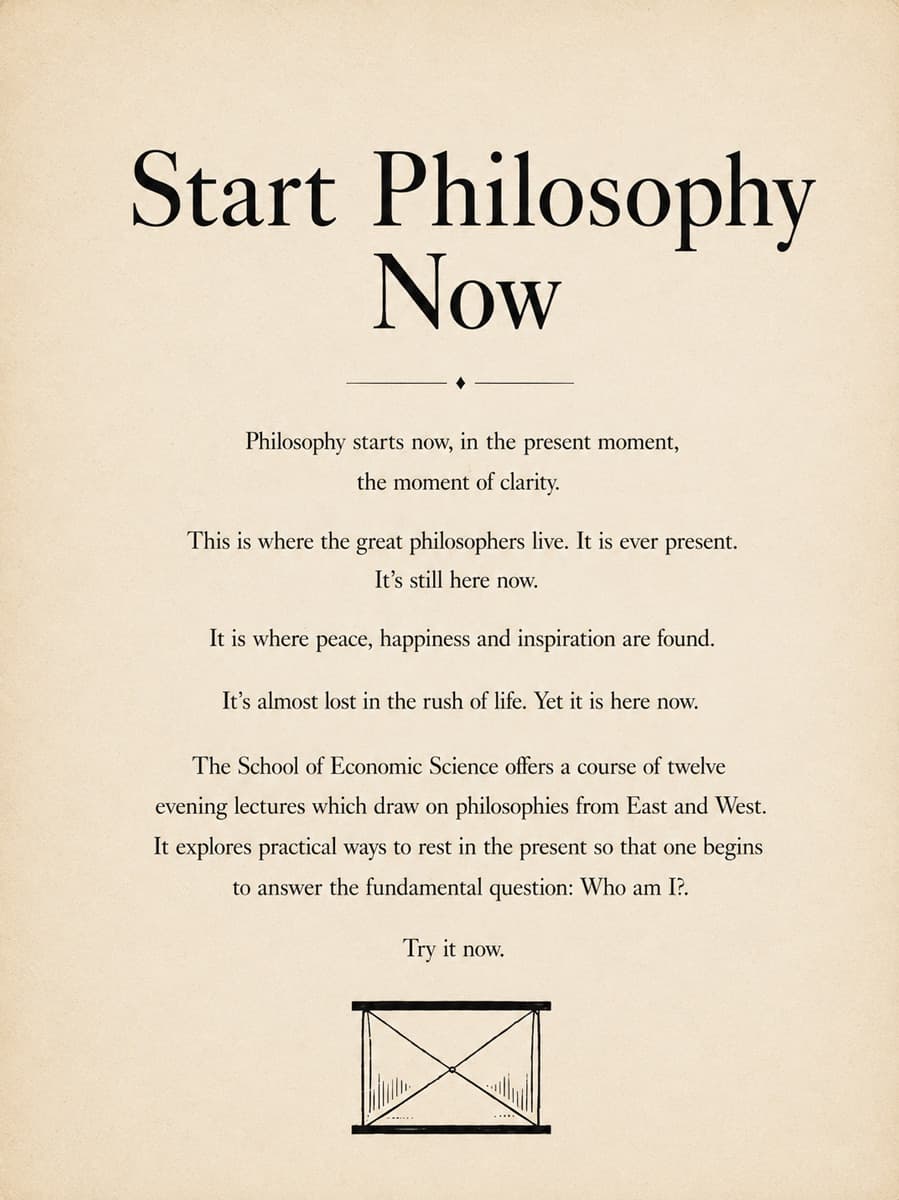
- II1950sPhilosophical Deepening
The curriculum expands to include Western philosophy: Plato, the Stoics, and the natural law tradition.
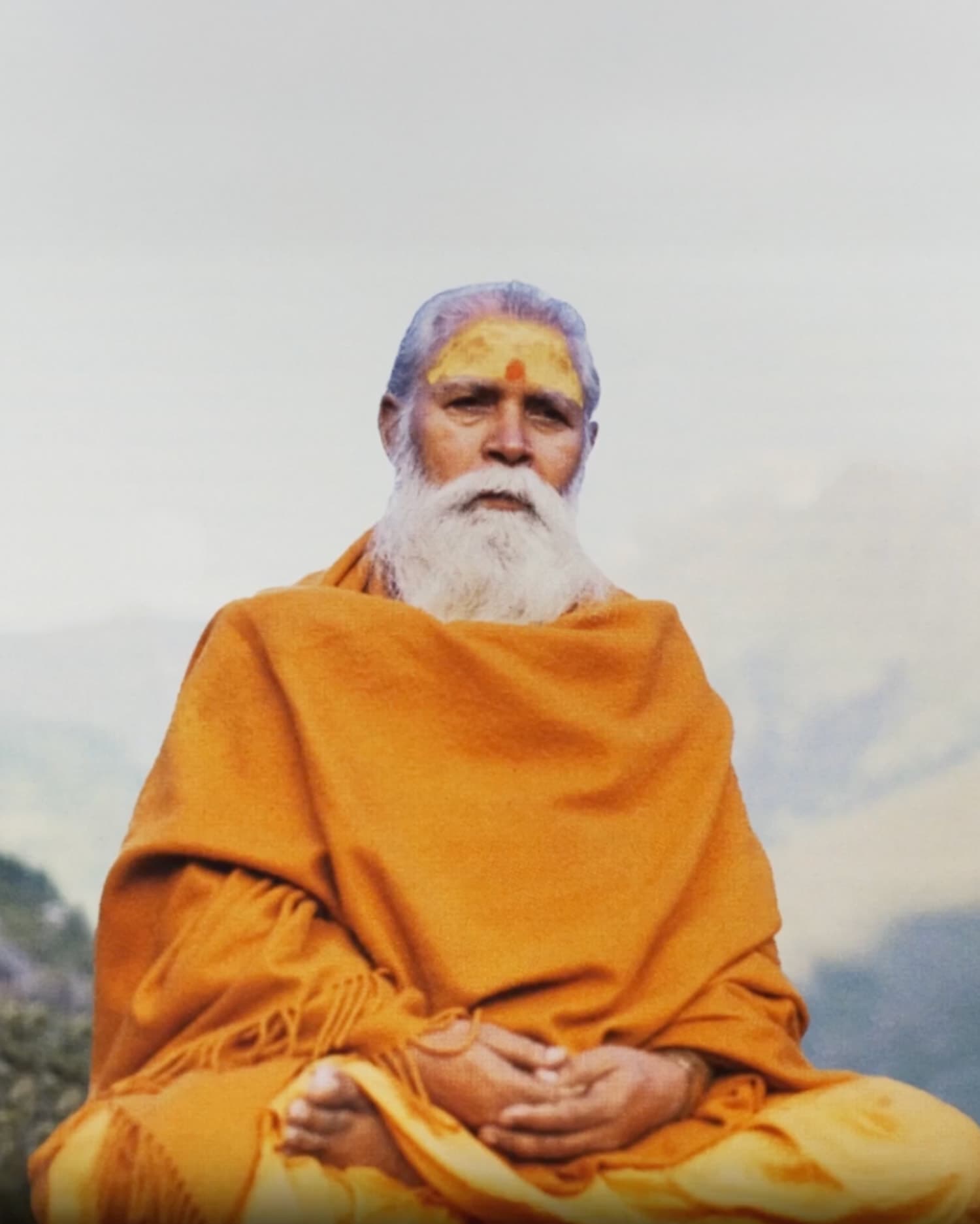
- III1961Eastern Encounter
Introduction to Advaita Vedanta and the practice of meditation through Shri Shantananda Sarasvati.
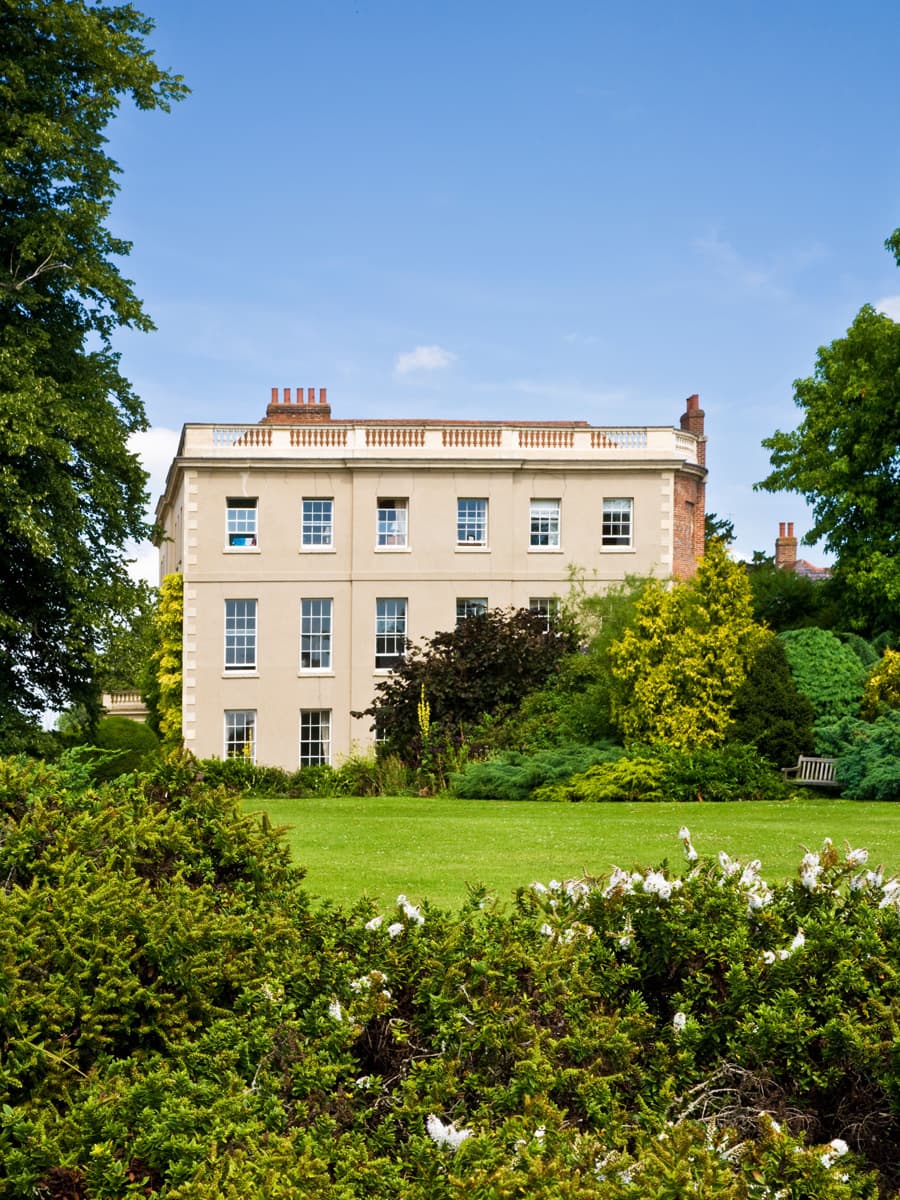
- IVPresentLiving Synthesis
A tradition refined through decades of study, practice, and dialogue, still unfolding through enquiry today.
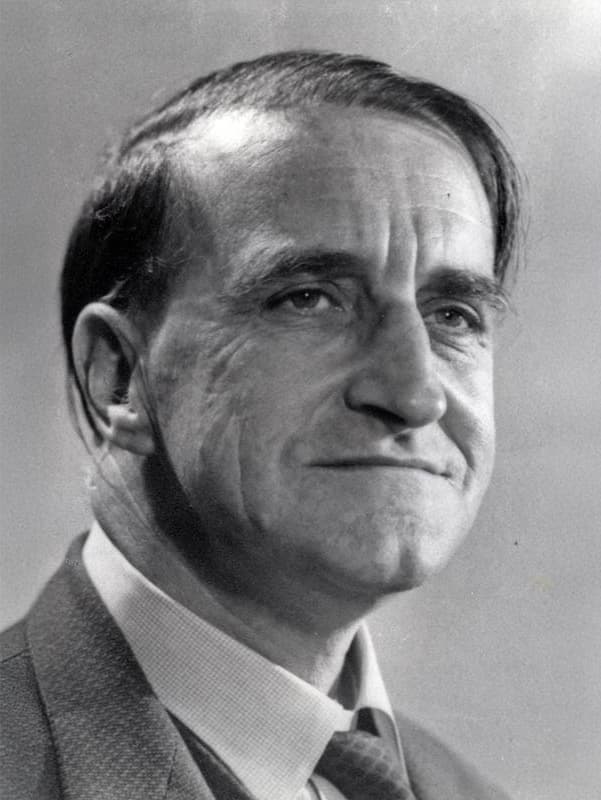
- I1937Economic Origins
Leon MacLaren founds the School of Economic Science, exploring questions of justice through political economy.
- II1950sPhilosophical Deepening
The curriculum expands to include Western philosophy: Plato, the Stoics, and the natural law tradition.
- III1961Eastern Encounter
Introduction to Advaita Vedanta and the practice of meditation through Shri Shantananda Sarasvati.
- IVPresentLiving Synthesis
A tradition refined through decades of study, practice, and dialogue, still unfolding through enquiry today.
Economic Origins
Leon MacLaren founds the School of Economic Science in London, drawing on the land-value taxation ideas of Henry George and the earlier work of his father Andrew MacLaren, Member of Parliament. The founding impulse is a practical one: to understand and correct the economic conditions producing poverty in industrial society.
First public lectures
The School begins offering public lectures on economics and social questions, open to anyone who wishes to attend. Enrolment grows steadily through the difficult conditions of wartime.
Philosophy added
Leon MacLaren concludes that economics alone cannot resolve the problems of the time. A philosophy course based on Plato is added to the curriculum. Enrolment reaches 150 in the first year and rises to 250 the following year. MacLaren reflects: 'It became very clear to me that there was such a thing as truth and there was such a thing as justice, and that they could be found and being found they could be taught.'
Introduction to Ouspensky and Gurdjieff
MacLaren is introduced to Dr Francis Roles and the Study Society in London, where he encounters the teachings of Peter Ouspensky and his teacher George Gurdjieff. Their search focused on practical methods of self-knowledge: concentrated attention, self-remembering, the integration of intellectual, emotional, and physical intelligence. Ouspensky, who died in 1947, held the system to be incomplete and directed his students to search for its source.
Meeting with Maharishi Mahesh Yogi
Dr Francis Roles and Leon MacLaren meet Maharishi Mahesh Yogi in London and recognise the method of mantra meditation as a critical and missing element. In 1961, the School helps organise a public meeting at the Royal Albert Hall where the Maharishi speaks to 5,000 people. The School introduces meditation practice alongside its philosophy work.
Shri Shantananda Sarasvati
On a visit to India at the Maharishi's invitation, Dr Roles meets Shri Shantananda Sarasvati (1913 to 1997), the Shankaracharya of Jyotir Math in northern India and the head of an ancient tradition founded by Shankara. On hearing the teaching of Advaita (the philosophy of non-duality), Roles concludes that this is the source of the knowledge they have been seeking. He introduces MacLaren to the Shankaracharya, and a thirty-year relationship of meetings and conversations begins.
Sanskrit studies begin
The School introduces the study of Sanskrit, enabling direct engagement with the primary texts of the Advaita tradition and of Vedic philosophy more broadly.
Waterperry House
The School acquires Waterperry House in Oxfordshire as a residential retreat centre. The house and gardens provide the setting for seminars, residential courses, and the annual festival that later becomes Art in Action.
St James Schools
The School supports the founding of St James Independent Schools, which offer education founded on the same philosophical principles. St James is a separate and independent institution, though the two share a common origin.
Marsilio Ficino translations
School members produce translations of the letters of Marsilio Ficino, the fifteenth-century Florentine philosopher and translator of the works of Plato. The translations make Ficino's letters available in English for the first time.
Art in Action
The School establishes Art in Action at Waterperry, an annual festival celebrating the arts and crafts. At its height it attracts over 30,000 visitors each year and features hundreds of artists and craftspeople working live before the public.
Leon MacLaren
Leon MacLaren dies. Donald Lambie, who had been a tutor and close student of MacLaren's since the 1960s, succeeds him as School Leader. The work continues without interruption.
Shri Shantananda Sarasvati
Shri Shantananda Sarasvati dies. The School's relationship with his successor, Swami Vasudevananda Sarasvati, begins. The tradition continues.
Mandeville Place
The School acquires the freehold of its Mandeville Place premises, establishing it as the long-term headquarters of the School's London work.
The Waterperry Frescoes
A series of frescoes, believed to be the largest of its kind in Europe for 500 years, commissioned for the artists' hall at Waterperry House is completed, painted by students and tutors of the School over several years. It depicts themes and teaching stories from the Advaita tradition.
Wisdom of Women
The School introduces a programme specifically addressing the philosophical traditions and the practical work of women within the School, past and present.
A living tradition
The School continues to offer courses in philosophy, economics, Sanskrit, and the arts at Mandeville Place and across its branches. The enquiry that began in 1937 is still alive. Leon MacLaren summarises its aim: 'The aim is truth. And truth, as we now know, is beyond creation. It is the self of every living creature. That is the aim. That is what it is all about.'